

Clinical intelligence workspace

When the clinical decision matters, open StewardMD.

Start a case, reason through it, check the drug against the patient in front of you, calculate the number, find the guideline. One workspace a doctor reaches for mid-round.

Get StewardMD See it think
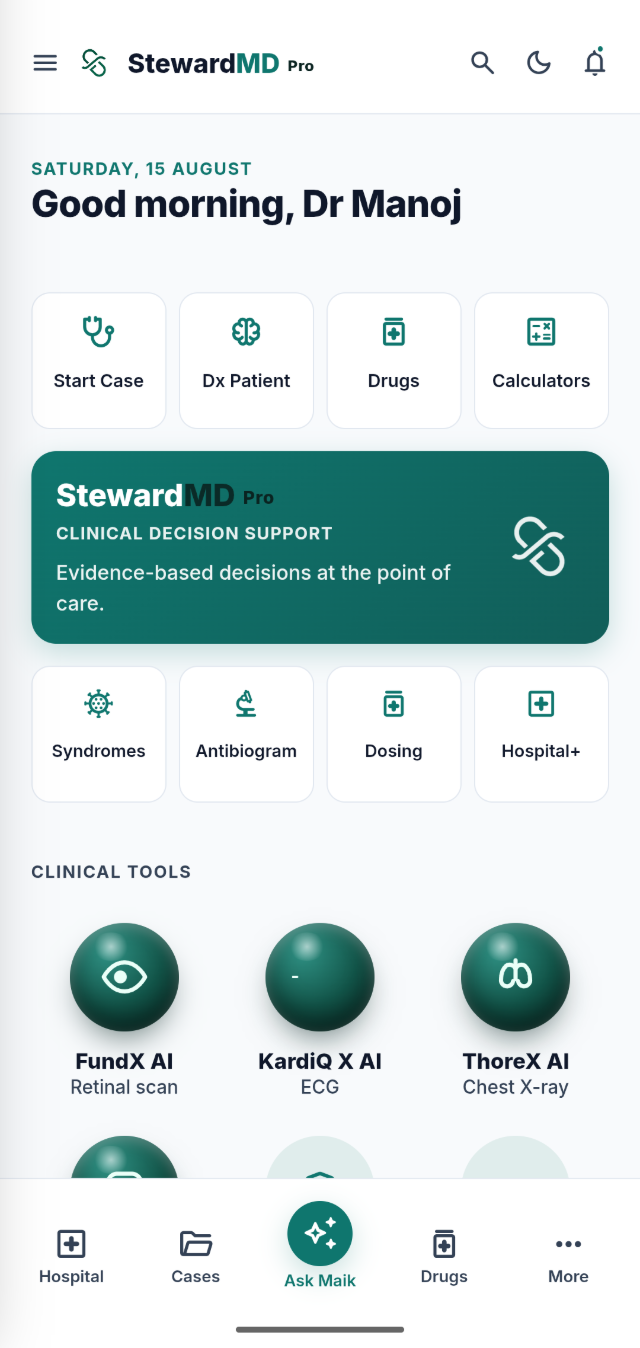
StewardMD Pro home screen: greeting, quick actions and the clinical tools grid
What opens inside StewardMD Twelve engines, one patient record
Case
Start a case
Open the patient in front of you
Think
Clinical reasoning
Findings in, ranked differential out
Decide
Antibiotic engine
Empiric cover for the syndrome and host
Verify
Drug index
Monographs, dosing, Indian brands
Check
Interactions
Scan a prescription, see the conflicts
Know
Disease reference
4,808 conditions, offline
Evidence
Guidelines
The layer the recommendation came from
Calculate
Scores
Wired to the diagnosis you are on
Dose
Insulin
Correction and bolus, with the working shown
Correct
Electrolytes
Sodium, potassium, water deficit
Region
Antibiogram
ICMR national data plus your local layer
Deeper
Oncology
Staging, RECIST, CTCAE, protocols

Clinician-only decision support. StewardMD does not diagnose or prescribe on its own; the treating doctor decides.

A patient presents a problem. The doctor thinks. StewardMD structures the reasoning, opens the right engine, and puts the evidence where the decision is being made.

Story one
Clinical Reasoning

A patient comes in confused.

Seventy-two. Febrile. Family says she has been drowsy since morning. No localising signs yet, and the picture could go several ways.

Start a case. The findings go in as they are elicited, not after the round.

Each finding re-ranks the differential, and the engine shows what would discriminate between the leaders.

The doctor still decides. StewardMD makes the reasoning visible, and every candidate opens into its full reference.

Start a case Step 1 of 5
Findings
Fever Altered sensorium Age 72 Neck stiffness No focal deficit GCS 13
Working differential rule-based rank
Acute bacterial meningitis 74
Viral encephalitis 58
Metabolic encephalopathy 41
Sepsis-associated delirium 33
What would discriminate
CSF analysis Serum sodium Capillary glucose
Illustrative view. Candidates come from the app's reference set; StewardMD supports reasoning and does not diagnose.
Story two
Antibiotic Engine

The antibiotic is familiar. The patient is changing.

Day four of amikacin. On the round, the creatinine has drifted from 0.9 to 1.8 and the urine output is falling.

The engine reads the host factors with the syndrome: aminoglycoside exposure, falling clearance, KDIGO stage 1.

It lays out what the review needs: spectrum held, renal burden, local susceptibility, and the alternatives worth considering.

The doctor changes the drug. StewardMD carries the patient's clearance straight into the new dose.

Renal function KDIGO 1
Creatinine
0.9mg/dL
CrCl
62mL/min
Day 1 to day 4, on amikacin.
Review surfaces
Host factorAminoglycoside exposure, day 4
RenalClearance falling, dose interval affected
SpectrumGram-negative cover to be maintained
Local dataICMR AMRSN 2024, verify against your antibiogram
StewardshipWHO AWaRe class shown on every option
The engine assembles the review. It does not choose the antibiotic.
Meropenem AWaRe · Watch
Quick facts Indications Contraindications Adverse effects Interactions Monitoring
Renal dose uses this patient's CrCl
Adjusted for CrCl 31 mL/min
Standard1 g every 8 hours
Adjusted1 g every 12 hours
Illustrative. The app shows the formula, the assumptions and the source behind every calculated dose, and the clinician confirms before use.
Story three
Drug Index & Interactions

Two drugs. One question.

Type the list, pick from the drug index, pull it from Ward Sync, or photograph the prescription. On iPhone the text is read on the device before anything leaves it; where that is unavailable the image is read in the cloud. Handwriting near-misses are resolved against the index and shown to you for confirmation.

Interaction check Scan a prescription Type a list Pull from Ward Sync 2 medicines
On the prescription
Cl Clarithromycin Macrolide · read from the scan 500 mg
BD
At Atorvastatin Statin · already on the chart 40 mg
OD
Interaction 1 flagged
Duplicate therapy None
QT risk Reviewed
Renal burden Reviewed
Bleeding risk None
Severity
Minor
Moderate
Major
Contraindicated
Mechanism
Clarithromycin inhibits CYP3A4 raises Atorvastatin
Watch for Myopathy, and rhabdomyolysis at the severe end
Options Hold the statin, reduce the dose, or pick an antibiotic that does not inhibit CYP3A4
Decides You do. The engine surfaces the mechanism and the options, nothing more.
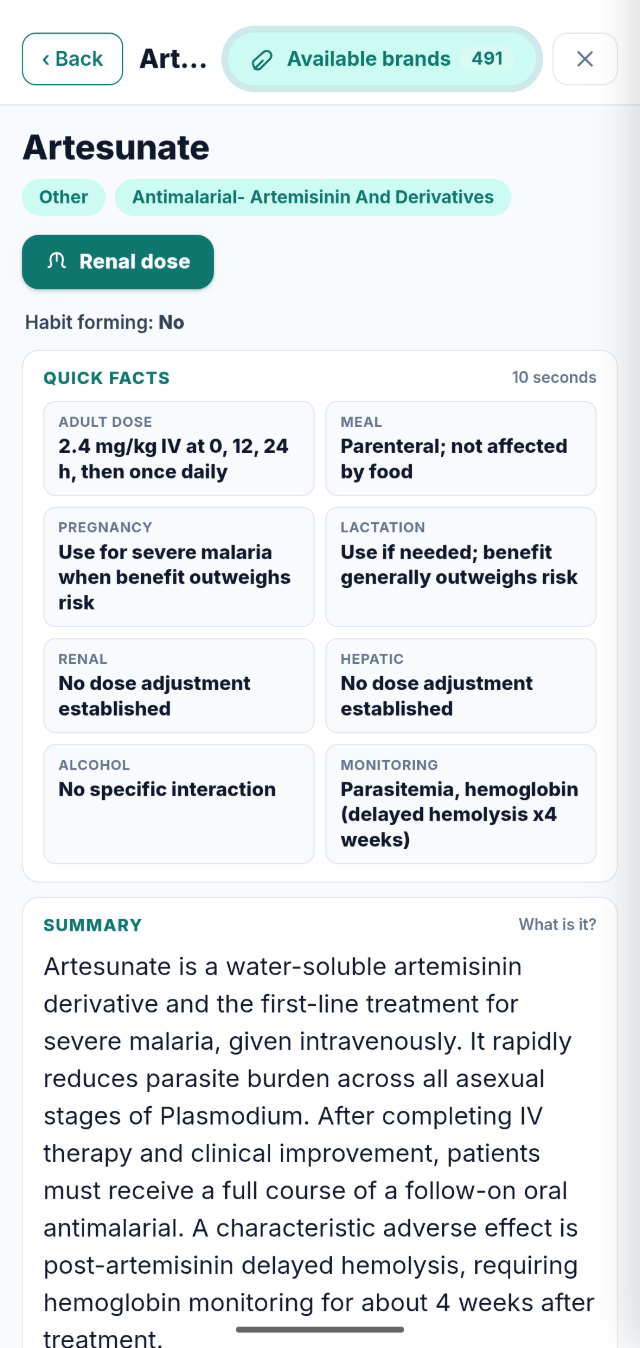
Artesunate monograph in StewardMD: adult dose, meal, pregnancy, lactation, renal, hepatic and monitoring quick facts

Then the drug itself.

Quick facts first, in the order a decision needs them: dose, with or without food, pregnancy, lactation, renal, hepatic, monitoring. Indications, contraindications and adverse effects sit under the same record, with Indian brand availability attached.

0
Indian brands in the national database

The same molecule can cost eleven times more.

Search a molecule or a brand. The record opens with every brand carrying it, each with its manufacturer, form, pack and price. Sort low to high, or narrow to top-branded or top-generic, and the affordable equivalent is visible before the prescription is written.

Search by brand or molecule Discontinued flagged Works offline
Available brands 491 ₹18 – ₹214
Show All Top branded Top generic
Sort Relevance Price: low to high Price: high to low
Lowest priced equivalent Tablet · strip of 10 · generic ₹18
Common generic Tablet · strip of 10 ₹46
Most prescribed brand Tablet · strip of 15 · branded ₹128
Highest priced brand Tablet · strip of 15 · branded ₹214
Load more 487 more Prices illustrative; live MRP from the database
Story four · disease knowledge
StewardMD Knowledge Base
More than everything a doctor needs.

The question doesn't always fit in one search box.

A condition opens as a linked record, not a page of prose. Disease, drug and guideline are connected, so moving from a diagnosis to its treatment to the evidence behind it never leaves the app.

0
disease references in the knowledge base
Standard references, then ICMR, then guidelines, then your hospital

The treatment hierarchy is explicit. Where a hospital overlay exists it takes precedence, and the app shows which layer answered.

Offline first

The clinical reference is on the device. A dead corridor signal does not take the knowledge base with it.

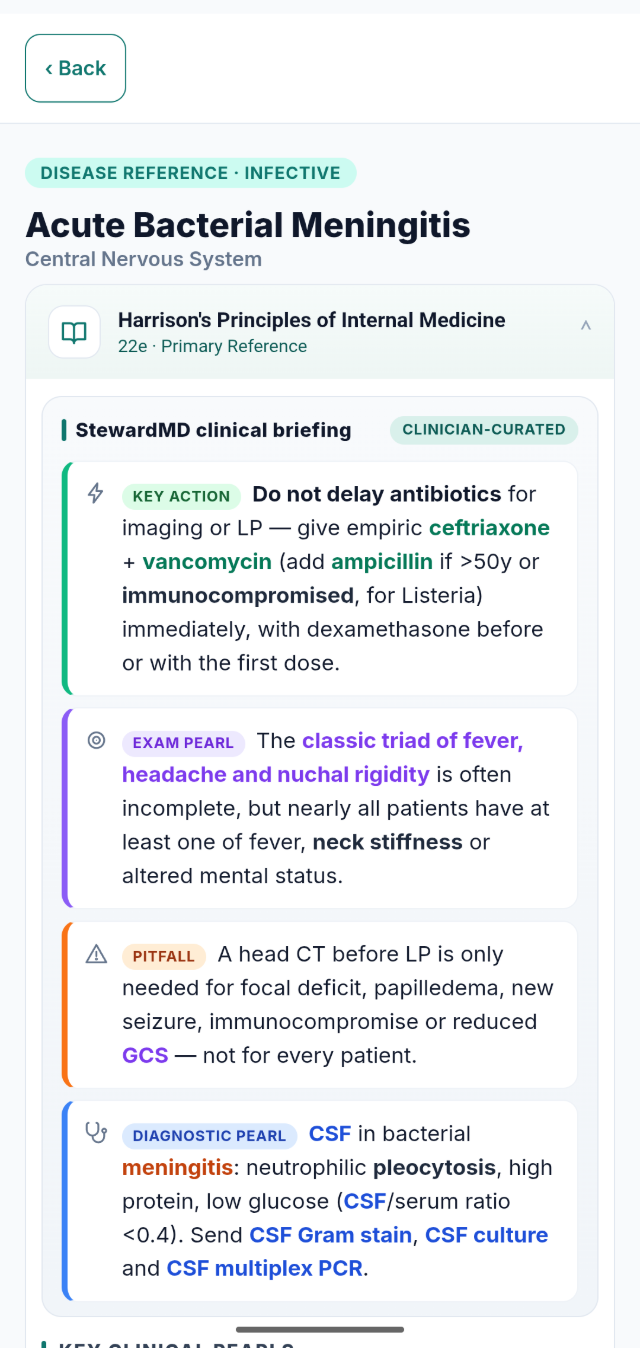
A StewardMD clinical briefing: key action, exam pearl, pitfall and diagnostic pearl for a condition
Reference record
Acute bacterial meningitis
Definition What the condition is, in the terms the reference uses.
Presentation How it shows up at the bedside.
Pathophysiology The mechanism behind the picture.
Diagnosis Investigations and what each one settles.
Management The approach, layered by evidence source.
Treatment Regimens, with the hierarchy that produced them.
Clinical pearls Clinician-curated notes worth remembering.
Guidelines The guideline layer the recommendation came from.
Rx guidelines Prescribing guidance tied to the same record.
Section names follow the app's own record structure. Content shown here describes that structure, not clinical guidance. Standard medical references and published guidelines are cited as sources only; StewardMD's clinical content is written by its own clinicians and is not a copy, adaptation or reproduction of any third-party work.
Ask MaiK
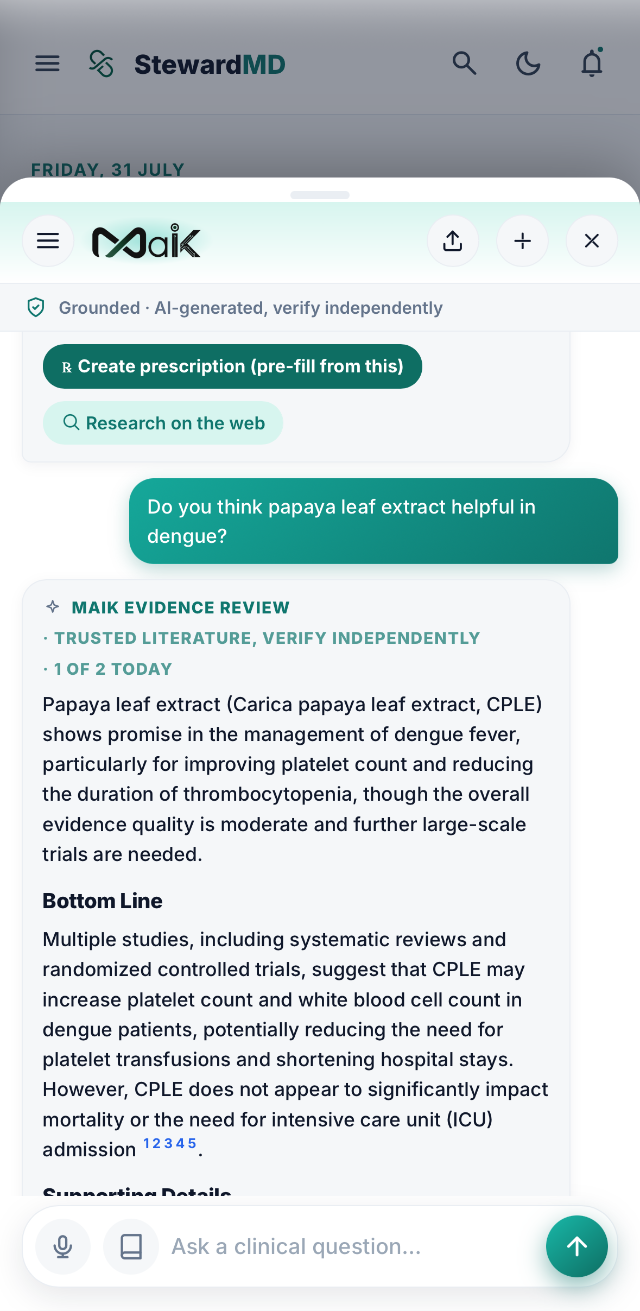
MaiK Evidence Review

Does papaya leaf extract help in dengue? It says where the evidence stops.

A bottom line, the trials behind it, and the limits stated plainly: platelet counts may improve, mortality and ICU admission do not. Grounded, AI-generated, verify independently.

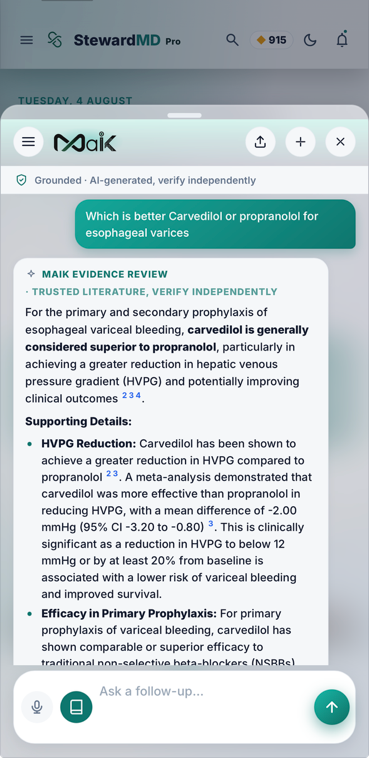
Carvedilol or propranolol? Ask it the way you'd ask a colleague.

A comparison question, answered as a review: which agent the literature favours, the mechanism behind it, the effect sizes, and numbered references you can open.

Knowledge base first Numbered citations Clinician-only scope
MaiK evidence review answering whether papaya leaf extract helps in dengue, with a bottom line and numbered citations
MaiK evidence review comparing carvedilol and propranolol for oesophageal varices, with numbered citations
Story five · the ward round
Calculators

When the number matters.

Bed 4. Sodium 118, and the correction rate is the whole question.

Bed 9. The opposite problem. Water deficit, and how fast it may be replaced.

Bed 12. Potassium 6.4 with ECG changes, and a protocol that has to be right first time.

Then a call from the ward sister about glycaemic control, and the insulin module opens with the patient's own parameters.

Every calculator shows its formula, its assumptions and its source. Insulin dosing is clinician-enabled and every recommendation needs an explicit confirm.

Bed 4 Sodium 118
Hyponatraemia correction
Serum Na
118
Weight
64 kg
Target rise
8 / 24 h
Calculated
Rate and volume, with the limit shown
The app shows the formula, the assumptions and the correction ceiling. The clinician sets the plan.
Bed 9 Sodium 158
Water deficit
Serum Na
158
Weight
71 kg
TBW factor
0.5
Calculated
Free water deficit, with the replacement window
Shown with its assumptions, and with the same clinician confirm before it is used.
Bed 12 Potassium 6.4
Hyperkalaemia
Serum K
6.4
ECG
Changes
eGFR
28
Surfaced
The protocol, and the scores that go with it
Reference and calculation together, so the sequence is not reconstructed from memory.
Ward call Clinician-enabled
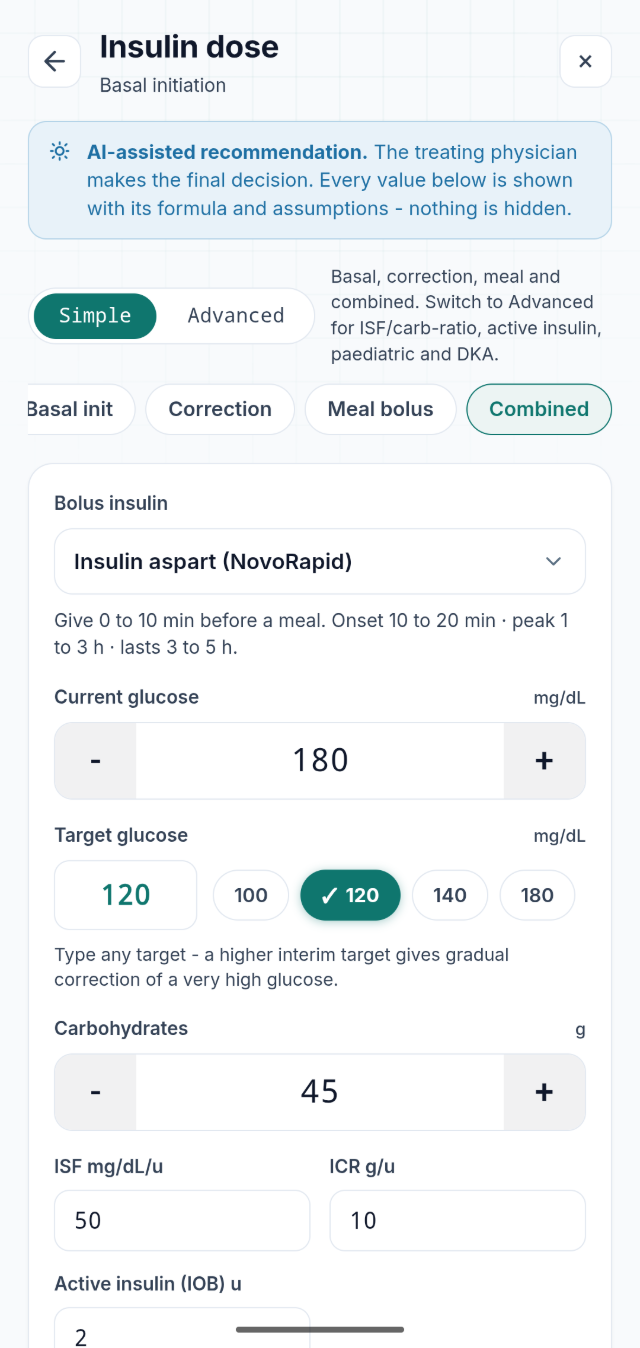
Insulin dose
Glucose
318
TDD
42 U
IOB
2.1 U
Recommended, pending confirm
Correction and meal bolus, IOB subtracted
Insulin dosing is off by default and enabled by the clinician. Every recommendation is stamped AI-assisted and needs an explicit confirm.

One calculator is useful. Hundreds are a toolkit.

Scores are wired to the diagnosis, so the relevant ones are offered where the case is open rather than hunted for in a list.

SOFA qSOFA NEWS2 SIRS APACHE II GCS FOUR score RASS CAM-ICU CURB-65 CRB-65 PSI SMART-COP DECAF CAT mMRC dyspnoea GOLD group PaO₂/FiO₂ A-a gradient Berlin ARDS Wells PE PERC PESI sPESI YEARS Wells DVT Caprini Padua Geneva CHA₂DS₂-VASc HAS-BLED ATRIA HEART TIMI GRACE Killip NYHA H2FPEF Duke criteria QTc MELD MELD-Na MELD 3.0 Child-Pugh Maddrey FIB-4 NAFLD fibrosis APRI BARD West Haven BISAP Ranson Glasgow-Imrie Glasgow-Blatchford Rockall AIMS65 Alvarado AIR score Mayo UC Harvey-Bradshaw NIHSS ABCD² Hunt and Hess WFNS Modified Fisher ICH score ABC/2 volume DRAGON THRIVE mRS KDIGO AKI FENa FEUrea CKD-EPI eGFR Cockcroft-Gault Creatinine clearance Urine anion gap Anion gap Corrected sodium Serum osmolality Effective osmolality Osmolar gap Corrected calcium Winter formula Sodium deficit Free water deficit Sodium correction rate Potassium deficit Bicarbonate deficit MASCC PLASMIC HIT 4Ts ISTH DIC CIWA-Ar COWS Curb severity Body surface area Ideal body weight BMI Parkland formula Maintenance fluids Corrected reticulocyte Transferrin saturation ISF and ICR from TDD Insulin correction dose Meal bolus Active insulin Basal initiation Infusion rate
StewardMD insulin dose calculator with basal, correction, meal bolus and combined modes

Every number shows its working.

The formula, the assumptions behind it and the source it came from are on the same screen as the result. Nothing is a black box, and the clinician confirms before anything is used.

A selection of the scores linked to diagnoses in the app.

Local resistance
Antibiogram

Antibiotic decisions don't happen in a vacuum.

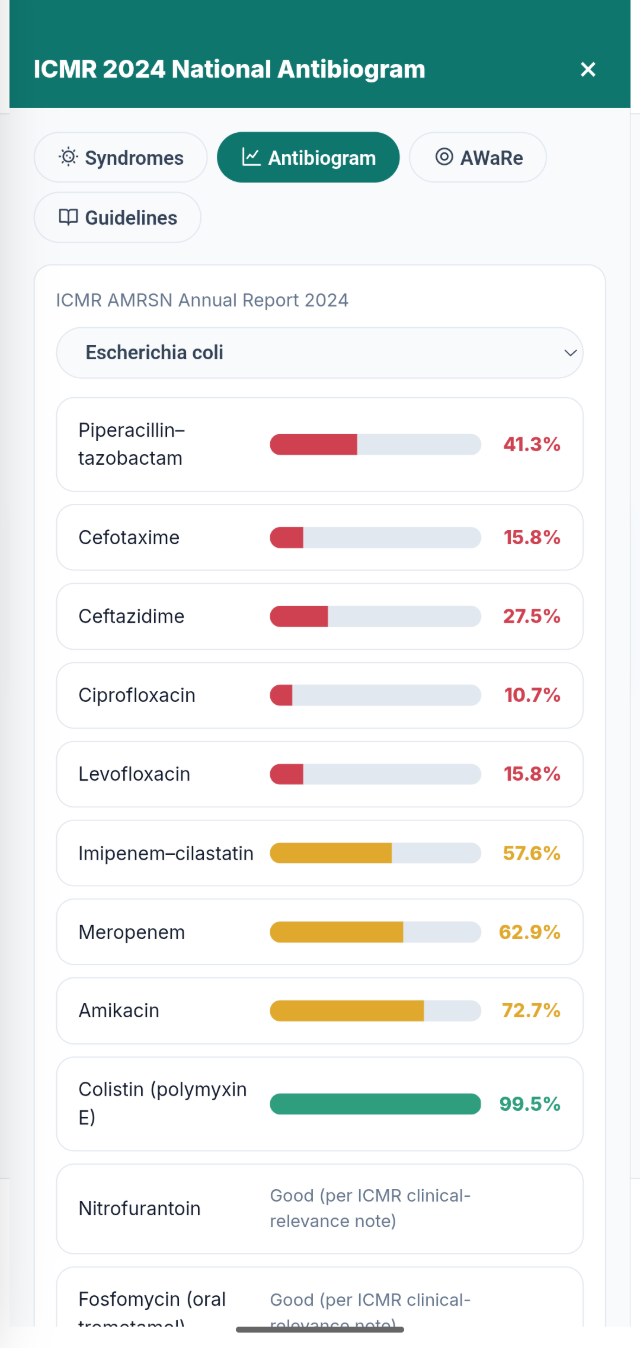
National susceptibility from ICMR AMRSN ships as the default layer, with WHO AWaRe classes and a spectrum-of-activity grid alongside it. The app is explicit that this is a reference: your local antibiogram, where you have one, decides.

ICMR 2024 national antibiogram in StewardMD: susceptibility percentages for Escherichia coli
E. coli · ICMR 2024 National layer
Colistin99.5%
Meropenem64.2%
Amikacin72.7%
Piperacillin–tazobactam41.3%
Ceftriaxone18.6%
Verify against local data before applying to your unit.
Story seven
Oncology

Some decisions demand deeper structure.

A woman with breast cancer returns for cycle three. The plan has to hold together across every visit, not live in one clinician's memory.

Stage and tumour type are recorded against a structured hierarchy, so the same cancer means the same thing at every visit.

Response is measured to a common standard rather than described in prose, and the trend across cycles is comparable.

Toxicity is graded on the same scale every time, and the protocol in use is the version that was reviewed and approved.

Cycle 3 · review Plan open
The plan, held across visits
TumourRecorded against a structured type hierarchy
StageCaptured once, carried through the record
LineThird cycle of the approved regimen
Structure first. Nothing here is a treatment recommendation.
Staging OncoTree
The same cancer means the same thing
HierarchyTumour type resolved against OncoTree
StageStructured fields, not free text
CarriedInto dosing, protocol and reporting
Consistency across visits is the point, not a second opinion.
Response RECIST
Measured, not described
TargetLesions measured to a common standard
CompareThis cycle against baseline and last
RecordAssessment stored with the visit
The clinician reads the imaging. The app keeps the measurement comparable.
Safety CTCAE
Graded the same way every time
ToxicityAdverse events graded on one scale
ImmunoImmunotherapy toxicity handled separately
ProtocolThe version in use is the one reviewed
NamingLook-alike drug names rendered to reduce error
Oncology unlocks for verified oncologists on Physician Onco+.

One clinical workspace. Hundreds of decisions connected.

The engines are not separate apps behind one login. A finding in a case reaches the reference, the reference reaches the drug, the drug reaches the dose, and the dose knows the patient.

The hospital layer

And when the doctor moves from the decision to the ward.

The clinical engine is the product. These modules carry the same record into the places the day actually happens.

ICU Workspace Flagship

The whole unit on one screen, one patient at a time.

Workspaces for vitals, labs, ABG, ventilation and the flowsheet, with trends, complaints and diagnoses, alerts and Lab Watch. The guided workflow runs findings into a working diagnosis and a deep review, and imaging can be imported and correlated.

Single modeLive today. One doctor holds the unit: add and update patients, import reports from the hospital system, or work from uploads when the connection will not cooperate.
Group modeBuilt and behind a flag, not yet deployed. Shared rounds, tasks and a team timeline for units where the ICU is covered by a team.
Bed 6 · overview Alert
MAP
62
HR
118
SpO₂
94%
Lactate
3.1
Urine
22 mL/h
K⁺
5.8
Lab Watch: potassium rising across the last two samples.

Ward Sync

From one shift to the next.

Live inpatient labs and radiology arrive from the hospital system into the record, and the same list can be pushed into an interaction check without retyping a single drug.

OPD Queue

The queue manages itself.

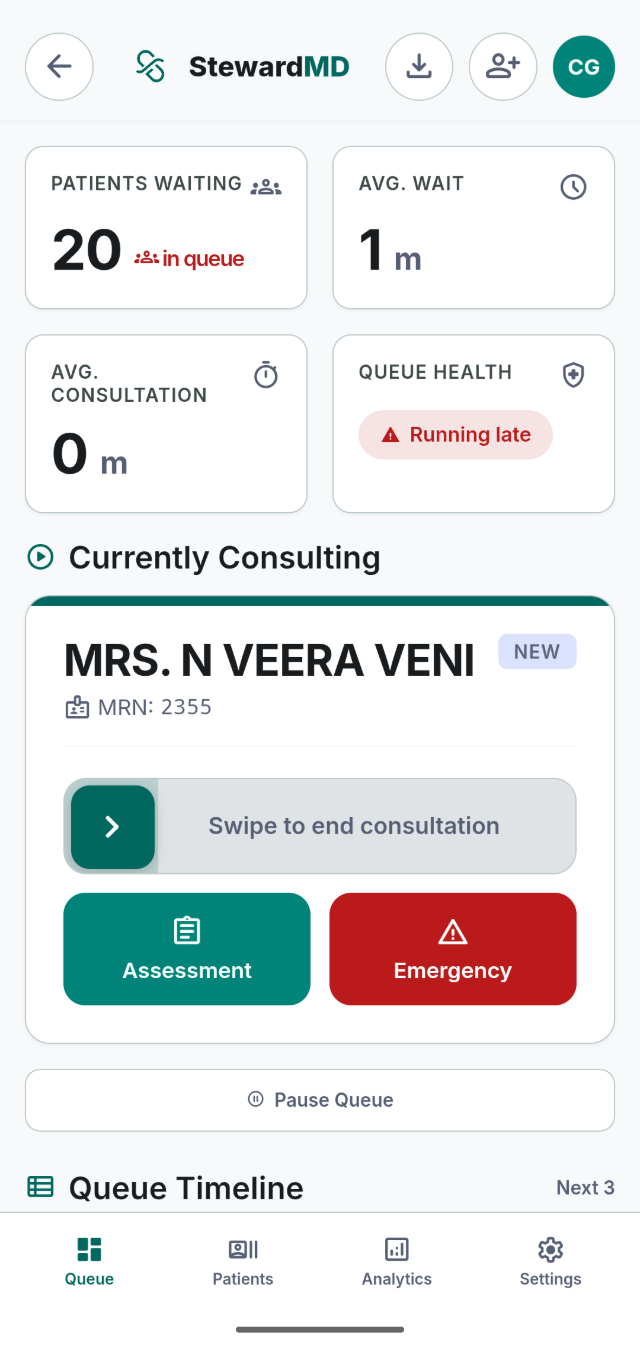
Tokens, rooms and departments in one live queue, with an emergency able to move to the front and the patient following their own position from a link rather than a corridor bench.

StewardMD OPD queue with patients waiting and average wait
How it works
01Patient registers and receives a token.
02They follow their live position from a link, not a bench.
03An emergency can be moved to the front of the queue.
04The doctor calls the next patient from the queue.
05Consultation opens straight into the record.
06The board and the analytics update as the clinic runs.

MaiK Scribe

Speak Telugu. Get a filled record.

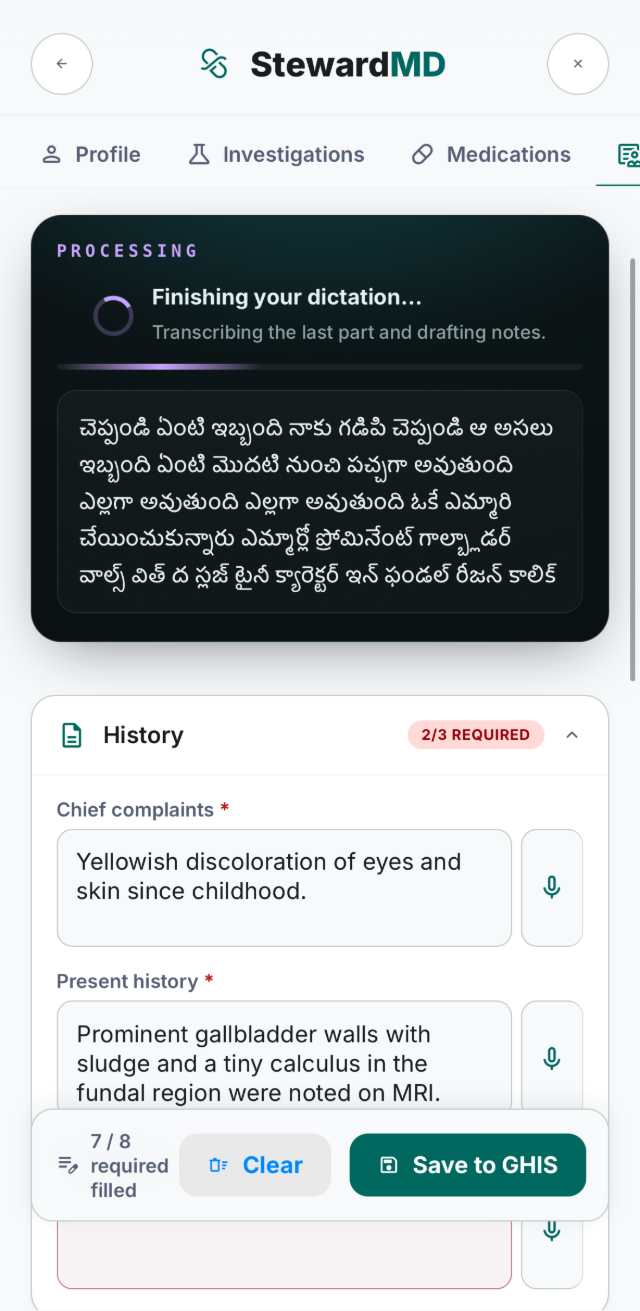
Dictate in the language you consult in. Scribe transcribes it, reads it for clinical content and drops it into the right fields, then shows how many required fields are still empty before you save to the hospital system.

SpokenTelugu, at consultation speed
FilledChief complaints, present history, investigations, medications
Guarded7 of 8 required filled, and you sign it
MaiK Scribe transcribing dictated Telugu into the record
How it works
01Start the consultation. Scribe records in the background.
02Dictate in Telugu, Hindi or English at normal speed.
03Speech is transcribed and read for clinical content.
04Complaints, history and examination land in their own fields.
05The required-field counter tells you what is still missing.
06You review, correct and save to the hospital system.
Always watching · phone and wrist
It keeps watching after you leave the room.

StewardMD does not stop at the bedside. Lab Watch monitors every new result around the clock and pushes the ones that matter to your phone and your wrist. And when a code is called, a resuscitation coach runs on the watch. The phone does the watching; the wrist makes sure you never miss it.

Lab Watch

The app watches the labs, so you do not have to.

Lab Watch runs inside StewardMD around the clock. For every patient you follow, it checks each new result the moment it posts against the limits you set. When a value crosses the line, the same alert lands on your phone and your wrist at once, with the bed, the value and its trend. A critical result never sits unseen in a queue, and a tap opens the record.

Runs 24/7 in the appStewardMD checks every new result day and night, whether you are at the bedside or off the floor. The monitoring lives in the app; it never sleeps.
Phone and wristThe same alert reaches your phone and your Apple Watch or Wear OS the instant a value turns critical, so it finds you wherever you are.
You set the limitsChoose the patients and the labs that matter and what counts as critical. Lab Watch flags only what you asked it to.
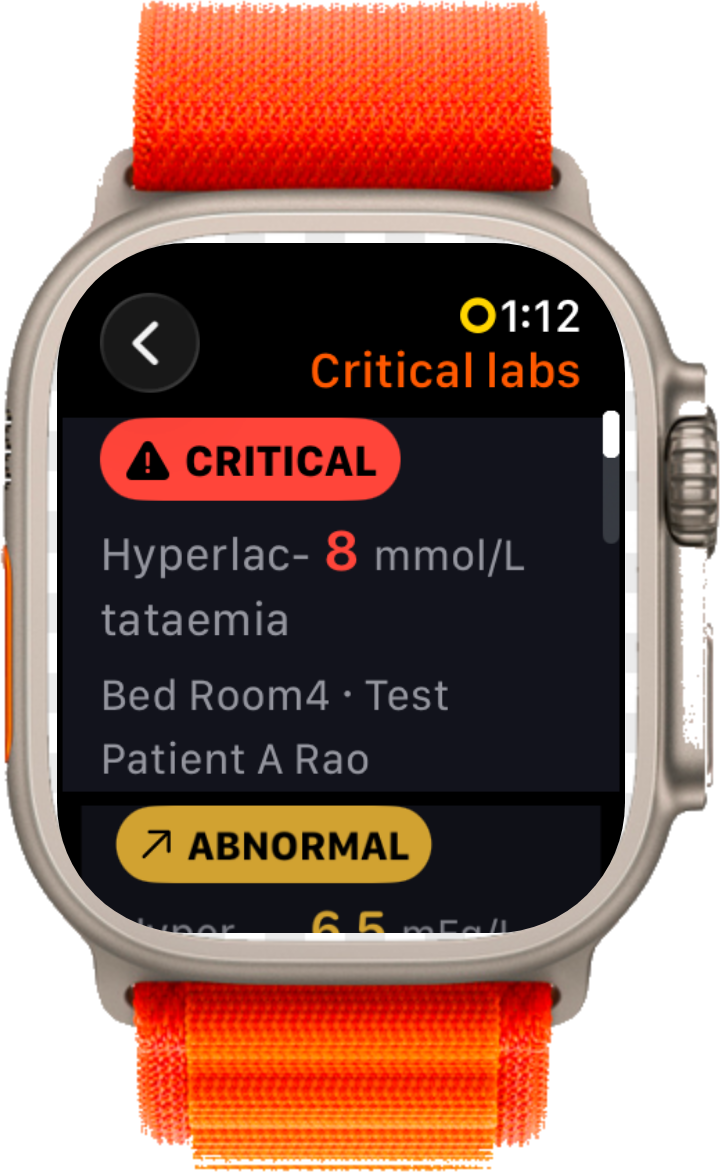
StewardMD Lab Watch critical alert on Apple Watch Ultra
StewardMD now · on your phone
Critical result · Lab Watch
Bed 4 · Lactate 8.0 mmol/L ▲ tap to open the record
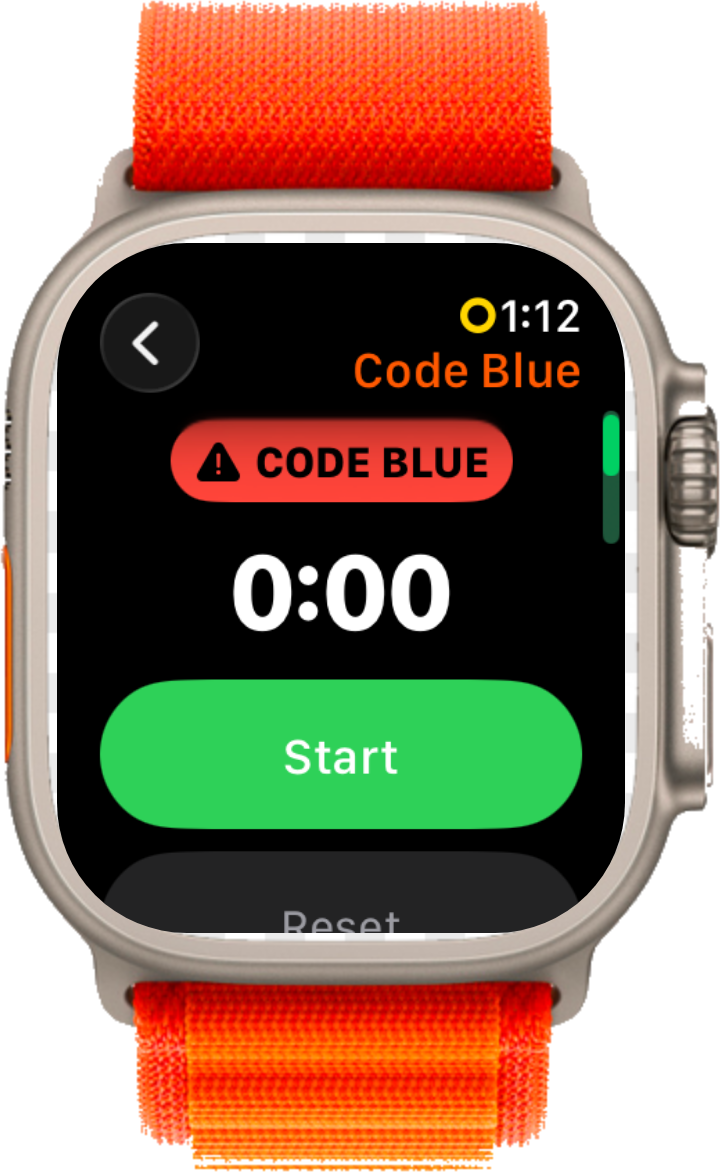
StewardMD Code Blue CPR coach on Apple Watch Ultra
Code Blue Live CPR assist

High-quality CPR, coached from the wrist.

Call the code and start compressions. The watch reads the motion in your own wrist, holds the beat, counts the cycle and runs the drug clock, so the team keeps its rhythm when the room does not.

Detects compressionsThe accelerometer in your own wrist counts every compression. No pads, no extra hardware.
Rate and depthLive coaching against 100 to 120 per minute and 5 to 6 cm, so the tempo never drifts.
Haptic metronomeA pulse on the wrist holds the beat when the room is loud and the clock is against you.
Cycle and drug timersThe 2-minute rhythm-check countdown and adrenaline intervals, called out on the wrist.
Debrief reportEvery compression, pause and shock, timestamped for the post-event review.

A notification is a prompt, never an order. The team runs the code and the doctor decides; the watch keeps the tempo, the timers and the record. It never replaces the resuscitation lead, changes a prescription or makes a diagnosis.

Story six
FollowCare

Discharge shouldn't mean disappearing.

A heart failure patient goes home. Every morning a link arrives, in their language, with the questions that matter for what they were discharged with. They never install anything.

The pathway is deterministic, not a language model deciding. Twenty-six pathways map the diagnosis to its questionnaire, the responses are scored the same way every day, and the trend is what the doctor sees.

Breathlessness Chest pain Pillows to sleep Leg swelling Weight
Recovery trend Stable
72D1
76D2
74D3
61D4
43D5
58D6
79D7
05 DAY
Score 43 down 18 overnight
DoctorNotified in the app, with the trend attached
PatientTold to reach the hospital now
NeverChanges a prescription, or makes the diagnosis
The doctor can respond
Send instructions Ask to come early Request a photo Request reports Share material

Ten actions in the Doctor Action Center, logged and auditable. Patient data is retained for seven days after recovery.

Safety and privacy

The doctor decides. Every time.

StewardMD is clinician-only software and is built to stay inside that boundary, technically as well as editorially.

The engine decides, AI explains. Suggestions are generated only after a rule-based result exists, and are labelled provisional.
No patient data in links, messages or logs. Clinical API traffic is never cached, and image and ward endpoints persist nothing.
Follow-up never prescribes. FollowCare cannot change a prescription, stop a medicine or diagnose definitively.
Reversible by design. Higher-risk modules sit behind flags you control, defaulting to off, and dose recommendations need an explicit confirm.
Pricing

Priced for the doctor first.

Students, interns and residents before institutions, with a 7-day free trial on every individual plan.

StudentStudy credits Disease reference, calculators, antibiogram and the drug index, for learning.No patient records, no Scribe, no hospital modules. ₹199₹129/month
InternEntry AI credits Everything in Student, plus saved cases and Ask MaiK.Reasoning, ward sync and Scribe stay locked. ₹299₹199/month
ResidentStandard AI credits Adds clinical reasoning, the antibiotic decision engine and Ward Sync.Single user. OPD queue and ICU group workflows are institution plans. ₹499₹299/month
Physician ProFull AI credits The whole clinical engine, MaiK Scribe, EMR and the hospital layer.Oncology modules are not included. ₹749₹579/month
Physician Onco+Full AI credits, oncology pool Physician Pro plus staging, OncoTree, RECIST, CTCAE, protocol dosing and review.Oncology unlocks only for verified oncologists on this plan. ₹1,199₹799/month
Medical colleges: write to hello@maiknowledge.in. Terms and conditions apply.

Clinical intelligence that stays with the doctor.

Built by clinicians, for clinicians. Subscribe, download, and sign in on your phone.

For qualified clinicians. Verification required at sign-up.
PlatformiOS · Android
Trial7 days
AccessClinician-verified
Supportsupport@stewardmd.in